






Life Cycle Assessment (LCA)
Transparently Assessing the Environmental Impacts of Products

What is a life cycle analysis?
Sustainability is becoming increasingly important in purchasing decisions. A solid data foundation is essential for accurately assessing the environmental impact of products. A key method for this is life cycle assessment (LCA) in accordance with ISO 14040 and 14044.
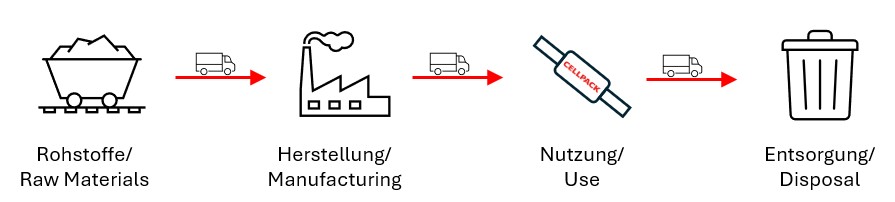
Life cycle analysis examines a product throughout its entire life cycle—from the extraction of raw materials through manufacturing and use to disposal or recycling. This process takes into account factors such as material use, energy consumption, transportation, and waste. The result is a comprehensive picture of a product’s environmental impact.

Why is LCA important?
LCA identifies the stages of the life cycle where the greatest environmental impacts occur. Based on this information, targeted improvements can be identified— where they make ecological sense and are also technically and economically feasible.
More Transparency
For us, life cycle assessment is, above all, about transparency. It provides clear information on where in the life cycle the levers for improving environmental impact lie, and forms the basis for Environmental Product Declarations (EPDs).
Life cycle assessment is thus an essential building block for sustainable and forward-looking product development.

What does CELLPACK do in the area of LCA?
By introducing a new position for product sustainability, CELLPACK is specifically strengthening the organizational integration of this forward-looking topic. This has established clear responsibilities for life cycle assessments (LCA) and environmental product declarations (EPD)—two key components for greater transparency in the environmental assessment of our products.
To ensure precise and comparable results, CELLPACK has also invested in specialized LCA software and a suitable database. This technical foundation enables standardized calculations that are transparent both internally and to our customers.
We are currently working on establishing and optimizing internal processes.
The goal is to clearly define responsibilities, workflows, and interfaces so that LCAs can be conducted efficiently and reliably.
At the same time, we are integrating life cycle assessment directly into the development process.
This ensures that environmental impacts are taken into account as early as the initial product phases. In the long term, this leads to well-informed decisions, sustainable product solutions, and consistent environmental data.